
Auf der Bacula Konferenz letztes Jahr hatte ich einen Vortrag gehalten, wie sich Bacula und vor allem auch Bacula Jobs und Pools durch Nagios oder Icinga überwachen lassen. In diesem Vortrag habe ich auch zwei Monitoring Plugins vorgestellt, die wir zum internen Einsatz entwickelt haben. Die beiden Plugins stehen auf unserem Community Portal netways.org zum Download zur Verfügung.
Mit dem Plugin check_bacula lassen sich einzelne Jobs überwachen, insbesondere ob ein Job in den letzten x Stunden erfolgreich abgeschlossen werden konnte. Wenn man den Jobnamen in Bacula gleich dem Nagios/Icinga Hostnamen wählt, spart man sich gleichzeitig auch etwas Konfigurationsarbeit. So wird das ganze konfiguriert:
[code lang=”bash”]
# Bacula Checkcommand
# -H: hours; -w: Warning; -c: Critical; -j: Job (Jobname=Hostname)
define command {
command_name check_bacula
command_line $USER1$/check_netways_bacula.pl -H $ARG1$ -w $ARG2$ -c $ARG3$ -j $HOSTNAME$"
}
# bacula jobs
define service {
use bacula-template
hostgroup_name bacula-win, bacula-linux
host_name another_client
service_description backup-jobs
check_command check_bacula!27!1!1
servicegroups backup
}
[/code]

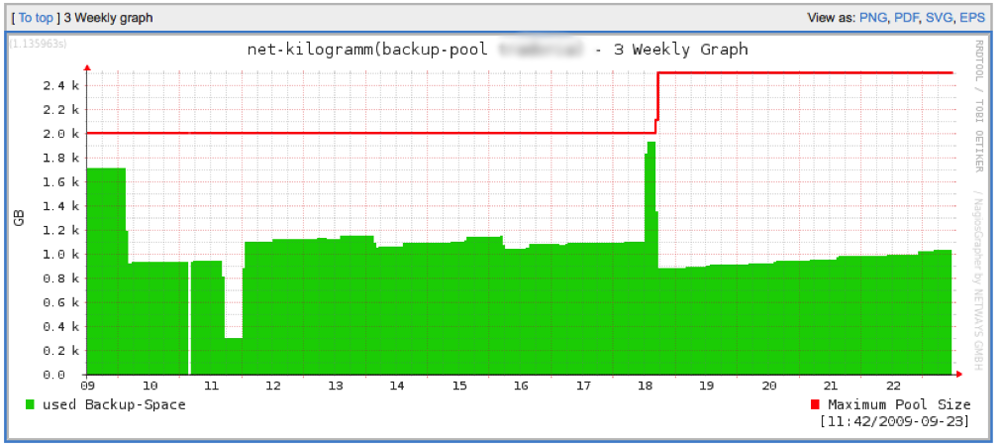
Das zweite Plugin count_bacula dient der Überwachung von Poolauslastungen, bzw. Poolgrößen. Damit lässt sich automatisch feststellen, wenn der Platz in einem definierten Pool zur Neige geht. Das Ergebnis kann man dann auch sehr aussagekräftig mit NETWAYS Grapher visualisieren:
[code lang=”bash”]
define command {
command_name check_backup_poolsize
command_line $USER1$/count_bacula -pool $ARG1$ -w 75 -c 90
}
define service {
use generic-service
host_name Bacula_Server
service_description backup-pool PoolName
check_command check_backup_poolsize!PoolName
}
[/code]














0 Comments